
Tesamorelin is a synthetic analog of growth hormone–releasing hormone (GHRH) that has been widely studied — and FDA-approved — in specific clinical contexts. It is known primarily for its ability to stimulate the pituitary gland to release endogenous growth hormone (GH), which then drives downstream effects such as fat metabolism and IGF-1 production.
What Is Tesamorelin?
Tesamorelin is a 44-amino-acid peptide modified to enhance stability compared to natural GHRH. The modification allows it to bind to GHRH receptors effectively and promote pulsatile GH release, rather than constant elevation of growth hormone. Its most well-studied clinical use is in reducing visceral adipose tissue (VAT) — the deep belly fat around organs — in people with HIV-associated lipodystrophy.
📊 Key Clinical and Research Statistics
Here are some of the most notable findings from clinical and controlled studies over the years:
- FDA Approval: Tesamorelin was approved in 2010 for reducing excess visceral fat in HIV-infected adults with lipodystrophy.
Visceral Fat Reduction: Phase 3 clinical trials showed average reductions of ~15–20% in visceral adipose tissue after 26 weeks of daily dosing (2 mg SC) compared with placebo.
Absolute Fat Change: In detailed imaging trials, Tesamorelin reduced VAT by roughly –24 cm², while placebo groups saw minimal changes.
Extended Efficacy: Continued treatment up to 52 weeks helped maintain fat reduction, though benefits often reverse after stopping.
Liver Fat: In people with HIV and nonalcoholic fatty liver disease (NAFLD), Tesamorelin reduced liver fat and increased the proportion of individuals achieving clinically normal liver fat levels.
Metabolic and Muscle Effects: Studies show improved adipose tissue density, increased lean muscle quality and area, and favorable metabolic changes without significant worsening of glucose metabolism.
How Tesamorelin Works (Simplified Diagram)
Below is a simplified conceptual flow of how Tesamorelin acts at the hormonal level:
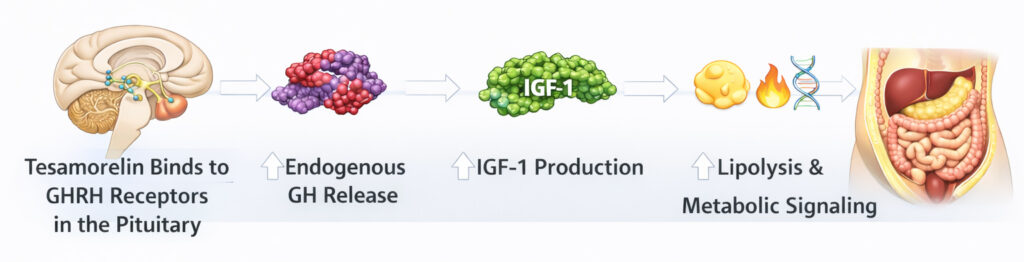
This cascade helps explain why Tesamorelin is often studied in research focused on body composition and metabolic regulation.
Beyond Visceral Fat: Broader Research Interests
While visceral fat reduction in HIV-related lipodystrophy remains the only regulatory indication, ongoing research has explored additional scientific questions:
- Metabolic health: Effects on insulin sensitivity and lipid metabolism in various models.
Muscle quality: Increases in muscle density and area observed in CT-based imaging studies, suggesting a potential influence on muscle composition.
Liver health: Evidence of liver fat reduction and potential protection against fibrosis in NAFLD research.
It’s worth noting that many of the expanded benefits seen in research models — such as anti-aging effects, cognitive parameters, and broader metabolic outcomes — are still under investigation and not universally confirmed in large clinical trials.
⚠️ Important Research Context
Although Tesamorelin has a strong clinical trial history for its approved use, it is not a general weight-loss medication, and results do not automatically apply to people without HIV lipodystrophy. Some key points:
- Monitoring: IGF-1 levels and glucose should be monitored during research or clinical use due to hormonal impacts.
Reversibility: Visceral fat reduction is not permanent — stopping treatment often leads to gradual reaccumulation.
Safety: Commonly reported reactions include injection-site reactions, mild edema, joint discomfort, and transient metabolic changes.
Summary
Tesamorelin is one of the most rigorously studied GHRH analogs in modern peptide science. Its clinical track record for visceral fat reduction in HIV-associated lipodystrophy is well supported by trial data showing consistent 15–20% average decreases over several months of daily dosing. While research continues into broader applications like metabolic health and adipose tissue biology, Tesamorelin remains primarily a research tool and clinical therapy in specific populations.
Shop Tesamorelin!
Support advanced research into growth hormone signaling and metabolic pathways.